Thursday, March 2, 2023

Leaves little to the imagination


Another plug for the City Stadium a.k.a Battlefield and its growing importance as green space


This Cinderella open space, for so long seen by Newcastle City Council as an opportunity for car parking or some other gimcrack idea, has become a marvellous facility for a large number of local residents and many visitors.

Trees that seemed permanently stunted and isolated between more well established parks to the north and the former industrial (now varied use) Ouseburn it overlooks. But in the last twenty years of close observation coinciding with this blog's life time, those trees that survived felling (by the Council) or storms have flourished. The prospects of this once forlorn green space are so improved it may be a struggle for some to remember how matters were.

The pandemic (amongst other pressures) suddenly propelled any patch of open ground into people's lives. There is only so much daytime television one can watch. People got out doors – safely distanced!

The Guardian reports on the national picture for tree cover. The facts aren't as good as we might wish, though sites such as lowland heaths shouldn't have much tree cover since that habitat is now semi-precious relic for its specialised wildlife; also Fenland (New Holland) ought not to be on the list of places laking tree cover. That too is a specialised near aquatic habitat, much of which has been drained already.

The revival of interest in all things natural and green, sparked at least as much by mental stability concerns as human physical health, is to be welcomed. Even on the City Stadium site there are opportunities for more planting; alongside Warwick Street for example.

Tuesday, December 20, 2022

Not Fade Away

 2022 coming to an end. Battlefield  abides.


Best Wishes for the Holidays & 2023

Monday, November 7, 2022

The Wright Stuff

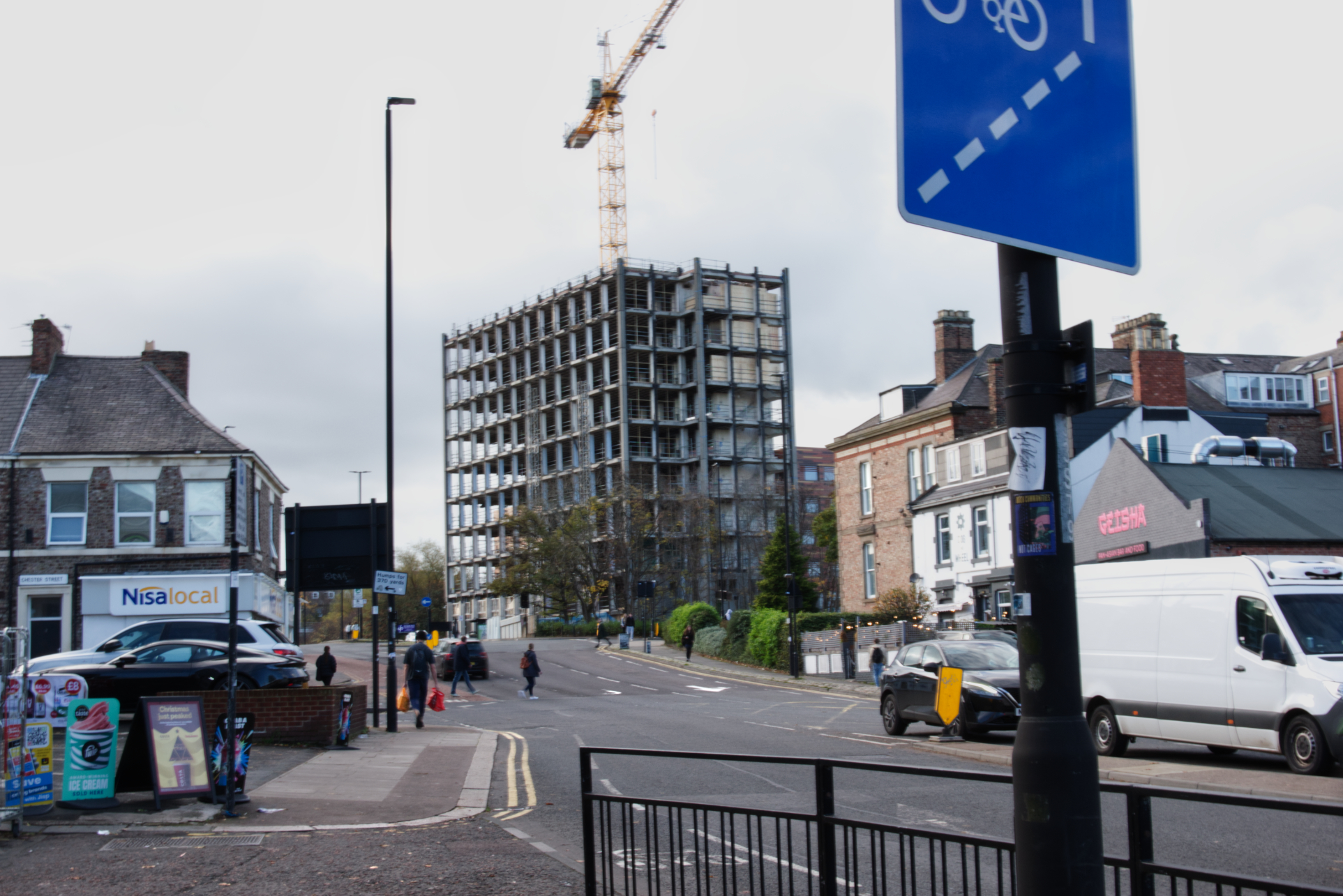
Former Tyne & Wear Council offices on Sandyford Road

A friend once invited me one evening to meet a man who had shook hands with Frank Lloyd Wright. We met up at the Jesmond Station besides the former Scottish Life office complex on Sandyford Road, just then being converted into apartments. As we chatted the man who had met Wright pointed at the 'skinned' block opposite now just a series of reinforced concrete beams and vertical supports netting the setting sun. 'I just wish they would leave it like that'. 

I could see his point. What had been a clasp built box of unflinching mediocrity was now a Constructivist sculpture of elegance and poise making a weave pattern against the glowing sunset. It didn't stay that way but what it became was somewhat more aesthetically pleasing – discrete anyway.

That block and the associated tower block facing onto Sandyford Road was last occupied by the long gone Tyne & Wear Council.* For some reason developing the tower block was delayed – Covid? – but has finally begun. Before it disappears under some newer scheme of out facing covering, we can enjoy the sight of perhaps one of the best sculptures in the city.


This renovation leaves the Northumbria University's Claude Gibb building  close by as the least interesting tower block for miles a round.


Northumbria University's mediocre Claude Gibb tower block


*The history of the Tyne & Wear Council is here:

Those who knew claimed the Tyne & Wear Council had a more interventionist and imaginative policy outlook than those local councils that replaced it. Maybe that was the intention behind dissolution? 

Tuesday, October 18, 2022

Goodbye Ouseburn


Ouseburn Quays

It was always on the cards. Someone in a white Porsche would spot a 'market opportunity' arising from the 'chic' of urban lifestyle that arose in London's Dockland's, spread out to other places with areas of post industrial dereliction and produce expensive ways for the seriously better off to indulge their brush with edgy metropolitan actualité or, in theory, 'vibrant' arty people. What was once a cheap place no one else wished to live, a chance for people without money to get into interesting spaces – sometimes through squatting – became très à la mode, all over the world. 

Gradually this form of 'poverty entrepreneurship' made otherwise uninhabitable parts of defunct businesses or industry attractively picturesque if one had a creative eye attracted attention. Other places soon became a magnet particularly for the young and child free penniless – craftspeople, performance arts, makers or simply drop outs. A waterfront helped. That adventurism finally acquired what one former hippie turned billionaire describes as 'a financial character' – in spades.

In his autobiography Dancing Edge, Derek Jarman charts his own pioneering time in the abandoned Butler's Wharf, London in the 70s – a mini Warholian factory of his own – a creative experiment to match his painting and films, at once invigorating and sad; because 'market opportunities' evicted Jarman and others from such spaces, to be taken by the very wealthy wanting to pose as Bohemians in one of the most expensive cities in the world.

That was bad enough. But what attracted Jarman and others to urban dereliction paved the way to a outbreak of hideously corporate fakery. 'Loft living', once as uncomfortable as it sounds, afterwards recreated with full insulation, security cameras and double glazing.


Lower Ouseburn – corporate space

Ouseburn, at least where the most prominent part of the valley meets the Tyne, is being anaesthetised, neutered and controlled. The sight that made a visiting friend decades ago express his own liking for urban dereliction – and the creative possibilities of such were then so evident, is now the definition of Suburban bland. It is almost as if someone has designed and built a film set for those masters of alienation, Michelangelo Antonioni or Ingmar Bergman.

So, goodbye Ouseburn. It was fun while it lasted. Photo gallery here. (off site link)


Tuesday, October 11, 2022

Secluded St Ann's


St Ann's, Quayside

On the off chance I walked to look at St Ann's church on the Quayside. On the way I stumbled across St Ann's Close. It's an impressive example – and what's more, successful – example of post War architecture at scale; a planned estate of multi-storey living that in many other places didn't work, mostly discredited and demolished. Here however, it seems to have become a secret corner high above Ouseburn, hidden among trees.

What is inspiring has been the way the overall concept has been preserved and the clearly high building standards exe

mplified in fine brickwork, complete spall-free concrete, and intriguing walkways over head, linking angled housing blocks. The usual concomitants of other 'problem estates' – burnt rubbish, fly tipped domestic items and plain old household waste are entirely absent here.

In one corner an older survival from the 19th cum early 20th century has been artfully integrated into a recent scheme of apartments that would grace any city.

The trees planted at the time of building St Ann's Close have grown well. There is a sense of sylvan that also is rare in large scale developments. The whole plan seems to have produced in the fifty or so years since completion, a visionary harmony. That is something to celebrate and learn from.

Photo gallery here (off site link)